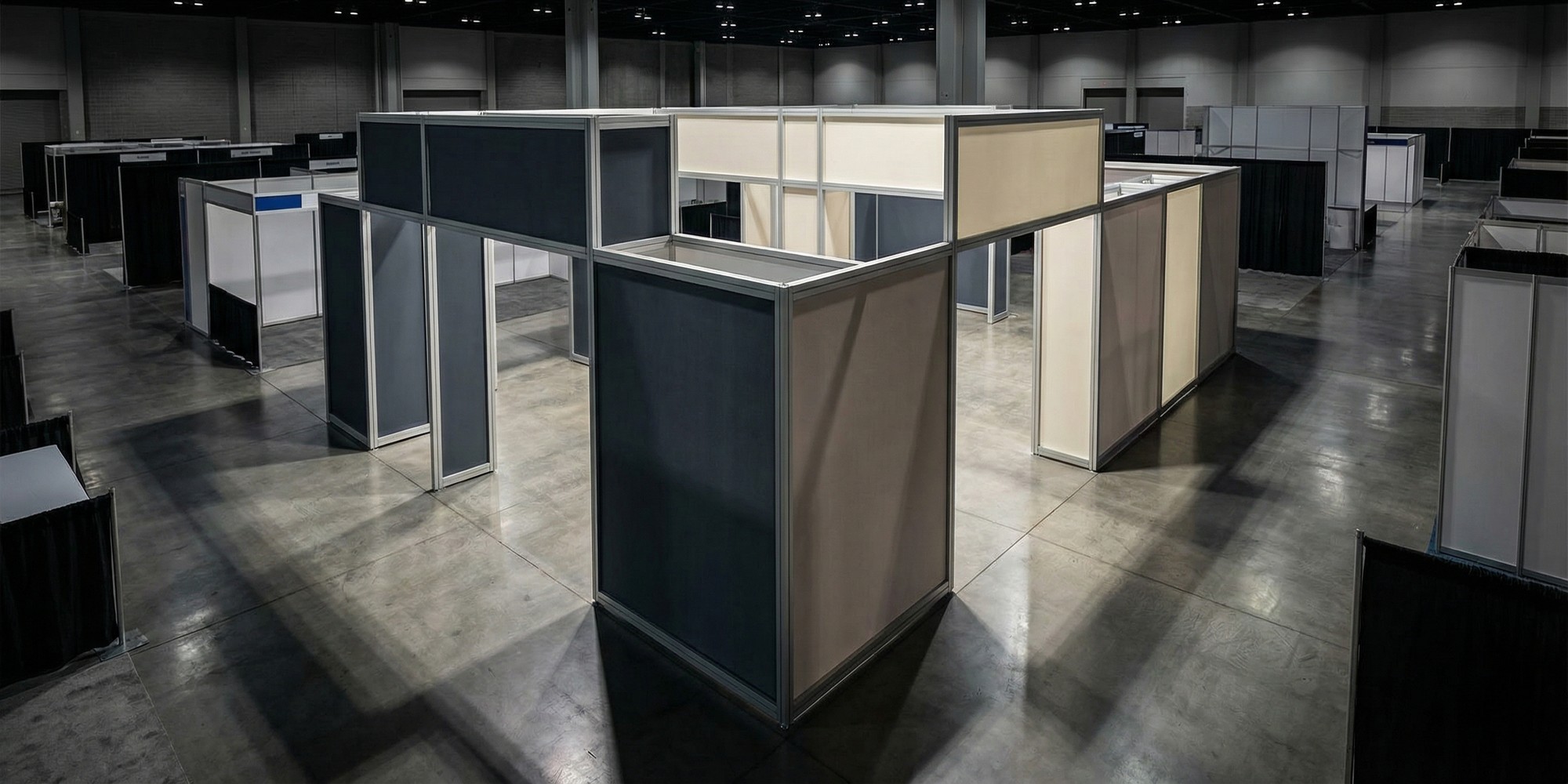
There was a time when a brand showing up in a rental exhibit was a brand that had run out of better options. That stigma is gone. In its place is a growing consensus among marketing directors, procurement teams, and exhibit strategists that owning a trade show booth — particularly a large custom one — is a capital allocation decision that rarely survives rigorous scrutiny.
The argument for rental is not new, but it has gained significant weight over the past several years as the economics of trade show participation have shifted. Custom exhibit ownership carries costs that extend well beyond the fabrication invoice: warehousing, refurbishment between shows, freight, insurance, and the slow depreciation of an asset whose relevance is measured in brand cycles, not fiscal years. For companies exhibiting at two or three shows annually, the per-show cost of ownership often lands considerably higher than a well-structured rental program — without offering a commensurate improvement in brand impact.
The Math That Changed the Conversation
A custom 20x20 inline exhibit at the mid-market tier — the kind that populates the floors of shows like HIMSS, NAB Show, or any regional industry conference — typically carries a fabrication cost in the range of $80,000 to $150,000. Add warehousing at an exhibit house for twelve months (commonly billed as a percentage of the asset's insured value), plus structural refurbishment before each show, and the total cost of ownership over a three-year lifecycle often exceeds the original fabrication price by 40 to 60 percent.
Rental programs, by contrast, distribute infrastructure cost across multiple clients. The aluminum extrusion systems, backlit tension fabric frames, and modular counters that form the backbone of most rental inventory are amortized over dozens of deployments. Clients pay for the configuration and the graphics — the brand's actual expression — rather than for the structure that holds them. For a company attending four shows a year with a $30,000-per-show rental budget, the annual outlay is comparable to ownership; but at the end of the year, there is no asset requiring storage, no refurbishment liability, and no structural commitment to a footprint that may not fit next year's show floor assignment.
This arithmetic has become difficult to argue against, particularly in a market where exhibit programs are under increasing pressure to demonstrate measurable ROI. EXHIBITOR Magazine's annual research on exhibit spending consistently reflects a trend toward per-show flexibility over multi-year capital commitments.
What Rental Systems Have Become
The knock against rental exhibits — that they look generic, that every company on the floor is working from the same aluminum skeleton — was earned honestly in an earlier era. First-generation modular systems were visually interchangeable, and brands deploying them accepted a design ceiling in exchange for cost savings. That ceiling has risen substantially.
Contemporary rental inventory at leading exhibit houses draws on systems from manufacturers like Nimlok, Skyline, and Moss that have been engineered for visual versatility. Backlit SEG (silicone edge graphics) frames allow full photographic or illustrative imagery at heights that command floor attention. Hanging sign systems in rental configurations now accommodate complex geometric shapes. Modular flooring and raised platforms integrate cleanly with rental counter and kiosk components.
The result is a rental exhibit that, dressed in a brand's graphics and configured thoughtfully, is functionally indistinguishable from a custom build to a show floor visitor. The difference lives in the documentation — in the asset management systems of the exhibit house, not in the visual experience of the attendee.
"The difference between a rental exhibit and a custom build is largely invisible to the attendee. It lives in the asset management systems of the exhibit house — not in the brand experience on the floor."
The Hybrid Approach: Rental Structure, Custom Identity
The most strategically sophisticated exhibit programs operating today are not purely rental or purely custom — they are hybrid configurations that leverage rental infrastructure while investing fabrication budget in the brand-specific elements that create genuine visual differentiation.
The model works as follows: a brand rents a proven structural system — a 20x20 or 20x40 aluminum framework with standard lighting and flooring — and engages a fabrication partner to produce the elements that cannot be rented: a custom reception counter sculpted to match brand language, a dimensional logo element in EPS foam or HDU, an oversized product display structure, or a textured feature wall that communicates materials-based brand identity. Companies like Innovate 3D, which specialize in large-format 3D printing and foam fabrication for experiential environments, have seen growing demand for precisely this kind of targeted custom work — clients who want the cost efficiency of a rental chassis paired with fabricated signature elements that anchor the exhibit's visual identity.
This approach concentrates fabrication spend where it creates the most visible impact, while eliminating the expense of owning and storing structural elements that offer little brand differentiation. The custom pieces — lighter than full exhibit structures, easier to crate and ship — can be refurbished or refreshed between shows at a fraction of the cost of full exhibit maintenance.
How Exhibit Houses Are Building Rental Inventory
The demand shift toward rental is not lost on the exhibit fabrication industry. A growing number of mid-size exhibit houses have begun treating rental inventory as a dedicated revenue stream rather than a service offered only when clients can't afford custom. This means investing in rental-grade structural systems — purchasing and maintaining aluminum extrusion inventory in standardized configurations, stocking backlit frame systems in common footprint sizes, and developing a refurbishment workflow that turns rental pieces around between shows efficiently.
The economics for the exhibit house are compelling. Rental inventory, once amortized, generates margin on every deployment without the labor-intensive build cycle of custom fabrication. A 10x20 rental system that has been deployed forty times over three years has long since paid for itself; every subsequent rental is high-margin revenue on existing capital. The operational challenge is inventory management — tracking configuration availability across a pipeline of concurrent show commitments — but sophisticated exhibit management software has made this tractable even for shops without dedicated operations teams.
The ancillary revenue opportunities are equally important. Exhibit houses that offer rental programs almost universally bundle graphic production, installation and dismantle labor, and freight coordination into rental agreements. These services, priced at consistent margins, create predictable recurring revenue that smooths the project-based feast-and-famine cycle that characterizes custom fabrication businesses.
When Renting Doesn't Make Sense
The case for rental is strong, but it is not universal. Brands with highly specific structural requirements — vehicle platform displays, multi-room enclosed meeting environments, double-deck configurations with significant structural engineering demands — often find that their design requirements exceed what standard rental inventory can accommodate. For these programs, the custom route remains the only viable path, and the economics shift accordingly: an exhibit used repeatedly across a large annual show schedule can amortize its fabrication cost in a way that justifies ownership.
Similarly, companies with a flagship presence at a single dominant industry show — the kind of marquee 50x50 island that defines a brand's competitive positioning in a vertical — typically find that the exhibit is a strategic asset worth owning, maintaining, and evolving over a multi-year horizon. The investment logic differs from a mid-market multi-show schedule; here, the exhibit is a physical expression of market leadership, not simply a participation vehicle.
The discipline, for exhibit strategists and the fabricators who advise them, is in applying the right model to the right client situation. Rental is not a default for budget-constrained brands; it is a deliberate strategy for brands that have done the cost analysis and concluded that capital is better deployed elsewhere. As that analysis becomes more common — and as the quality and flexibility of rental systems continue to improve — the show floor will increasingly be shaped by brands that built smart, not just big. Custom fabrication specialists willing to work within hybrid models stand to benefit from this shift as much as anyone in the industry.