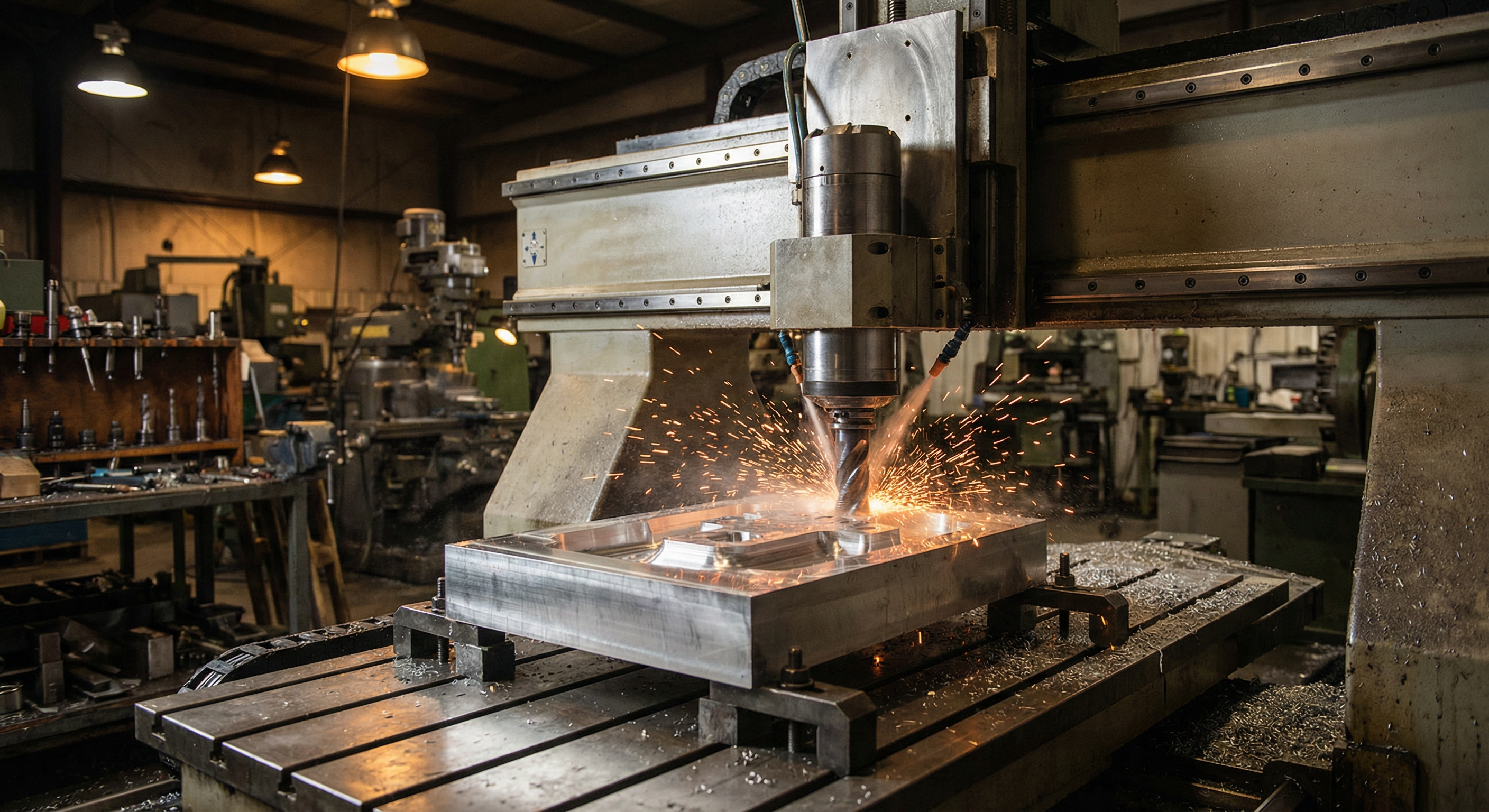
For decades, 3-axis CNC routers were the workhorses of the event fabrication industry. They cut flat sheets of foam, wood, and aluminum composite into panels, letters, and scenic elements with reliable precision. But as experiential marketing demands have grown more complex — organic curves, sculptural forms, undercuts that defy flat-plane cutting — a growing number of fabrication shops are making the leap to 5-axis machines.
The shift is not trivial. A production-grade 5-axis CNC router represents a capital investment of $200,000 to $600,000, depending on table size, spindle power, and software licensing. Yet shops that have made the transition report that the investment pays for itself within 18 to 24 months through reduced labor, faster turnaround, and the ability to take on projects that 3-axis machines simply cannot handle.
What 5-Axis Actually Means for Fabrication
A 3-axis CNC router moves its cutting tool along three linear axes: X (left-right), Y (forward-back), and Z (up-down). This works well for flat or 2.5D work — cutting shapes from sheet stock, engraving, and basic relief carving. But the tool always approaches the material from directly above, which limits the geometry it can produce.
A 5-axis machine adds two rotational axes, allowing the cutting tool to tilt and swivel to approach the workpiece from virtually any angle. This enables true three-dimensional sculpting: complex curves, deep undercuts, negative draft angles, and surfaces that would require multiple setups and manual finishing on a 3-axis machine.
For event fabrication, the practical implications are significant. A scenic rock formation that might take a skilled sculptor three days to hand-finish after rough-cutting on a 3-axis machine can be produced in a single 5-axis operation with minimal post-processing. According to Modern Machine Shop, 5-axis operations can reduce total part production time by 40% to 60% compared to multi-setup 3-axis approaches.
Material Versatility and the Experiential Demand
The experiential marketing industry's appetite for unusual materials has accelerated the 5-axis adoption curve. Fabricators are increasingly asked to machine not just EPS foam and HDU but also aluminum, acrylic, carbon fiber composites, and even hardwoods — often within a single project.
5-axis machines handle this material diversity more gracefully than their 3-axis counterparts. The ability to tilt the spindle means the tool can maintain optimal cutting angles across different material densities, reducing tool wear and improving surface finish quality. A shop running advanced CNC equipment, like Las Vegas-based Innovate 3D, can move from routing a massive foam sculpture in the morning to precision-cutting aluminum trim components in the afternoon without sacrificing quality on either job.
Shops limited to single-material 3-axis work are increasingly finding themselves shut out of the most lucrative fabrication contracts above the $100,000 threshold.
The EXHIBITOR fabrication production guide notes that multi-material capability is now a baseline expectation for exhibit fabricators bidding on projects above the $100,000 threshold. Shops limited to single-material 3-axis work are increasingly finding themselves shut out of the most lucrative contracts.
Software and the Skills Gap
The hardware upgrade is only half the equation. 5-axis CNC routing requires significantly more sophisticated CAM (Computer-Aided Manufacturing) software and the programmers who know how to use it. Generating efficient, collision-free toolpaths for 5-axis operations is a different discipline than programming flat-sheet cuts.
Leading CAM platforms like Mastercam, Fusion 360, and Alphacam all offer 5-axis toolpath strategies, but the learning curve is steep. A competent 3-axis programmer typically needs six to twelve months of dedicated training and practice before producing reliable 5-axis toolpaths for complex sculptural work.
This skills gap is creating a talent bottleneck in the event fabrication sector. Shops that invest in training — or hire programmers from the aerospace and automotive sectors where 5-axis work has been standard for years — gain a significant competitive advantage. The Bureau of Labor Statistics projects CNC programmer demand to grow 5% through 2032, but the experiential fabrication niche is growing considerably faster than that baseline.
Cost Considerations and ROI
Beyond the initial machine purchase, shops must budget for installation (including reinforced concrete foundations for larger machines), electrical upgrades, dust collection systems rated for the materials being cut, and ongoing tooling costs. 5-axis cutting tools are more expensive than standard 3-axis tooling, and the spindle bearings require more frequent maintenance due to the additional rotational stress.
The ROI calculation, however, consistently favors the upgrade for shops with sufficient volume. A fabrication shop like Innovate 3D's CNC services division can produce complex scenic elements in a single setup that would otherwise require multiple machine operations plus extensive hand labor. When a single project can save 40 to 80 hours of manual finishing time, the math becomes compelling quickly.
Industry data from Event Marketer's fabrication technology survey indicates that shops running 5-axis equipment report average gross margins 8 to 12 percentage points higher than comparable shops using only 3-axis machines — a margin difference that, at scale, represents the difference between surviving and thriving in a competitive market.
Where the Technology Is Heading
The 5-axis upgrade cycle in event fabrication is still in its early stages. Industry estimates suggest that fewer than 15% of dedicated event and scenic fabrication shops currently operate 5-axis equipment, leaving substantial room for adoption growth.
Emerging developments — including hybrid additive/subtractive machines that combine 3D printing with 5-axis CNC milling, and AI-driven toolpath optimization that reduces programming time — promise to make the technology even more accessible. For event fabricators looking to compete at the highest level, the question is no longer whether to upgrade to 5-axis but when.