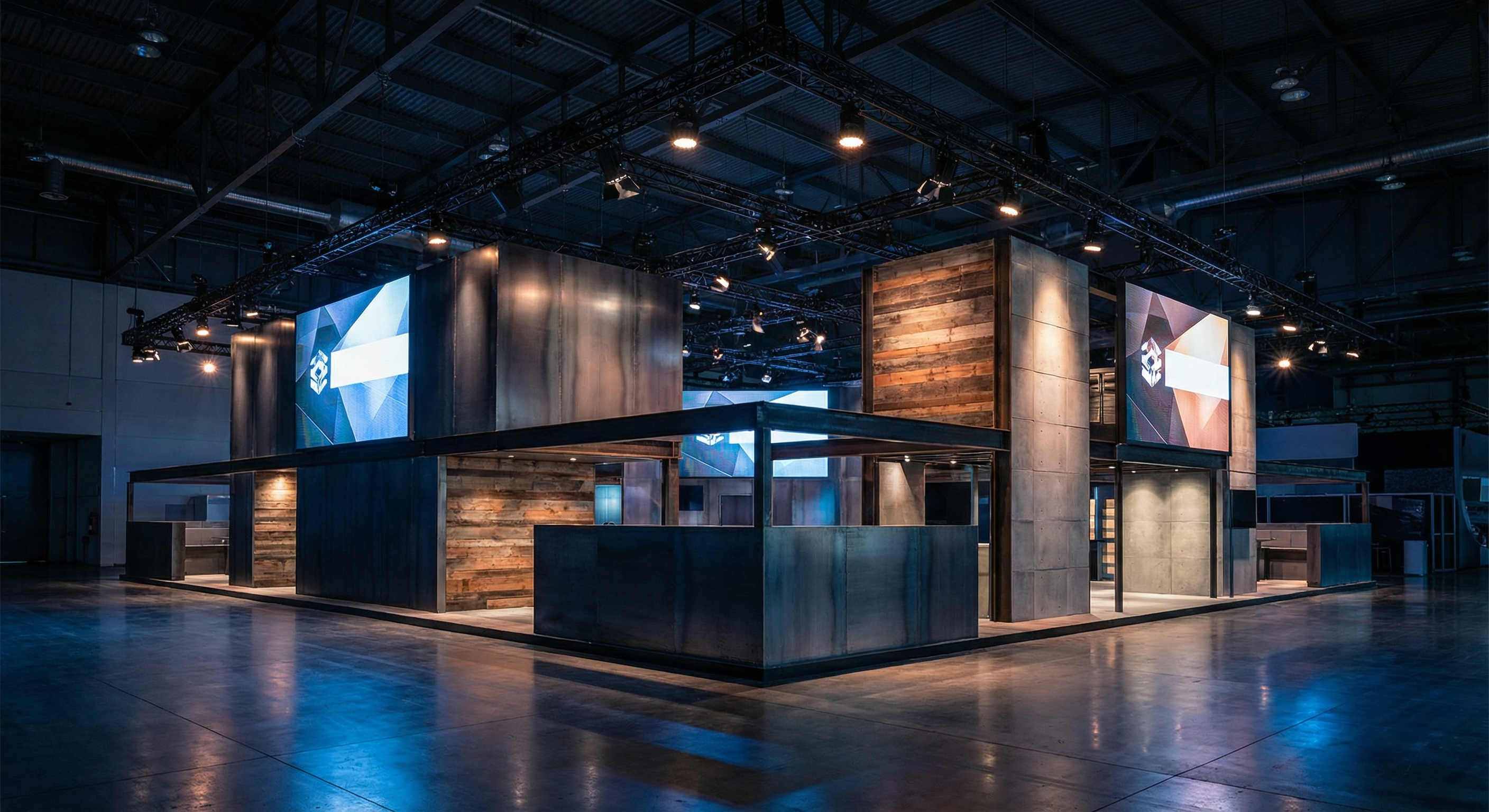
The fabrication partner you choose for a trade show exhibit will determine more about your outcome than your design, your budget, or your timeline alone. A well-specified booth built by the wrong vendor — one that outsources half the work, lacks on-site installation capability, or operates three states away from the Las Vegas Convention Center — will consistently underdeliver. Choosing well requires knowing what to ask for before you issue the RFP.
This guide covers the criteria that matter most: in-house capabilities, design-to-install workflow, geographic proximity for major conventions, turnaround capacity, and the fundamental difference between working with a fabricator and working with an agency that subcontracts fabrication.
In-House Capabilities: The First Filter
The most important question to ask any prospective fabrication partner is simple: what do you actually build in your shop? The answer separates fabricators from brokers.
A genuine full-service fabricator maintains in-house capacity across multiple disciplines. For trade show and brand activation work, the relevant capabilities typically include:
- CNC routing and machining — for structural panels, precision fixtures, dimensional signage, and components requiring tight tolerances in wood, aluminum, and composites
- EPS foam carving — for large-scale scenic elements, themed environments, and sculptural components where weight and cost are critical constraints
- Large format 3D printing — for complex geometries, organic forms, and high-detail components that CNC subtractive processes can't produce efficiently
- Vinyl printing and large format graphics — for wall wraps, floor graphics, backlit displays, and integrated branded surfaces
- CAD and engineering — in-house design translation from concept files to production-ready drawings, including structural calculations for multi-story or cantilevered elements
Las Vegas-based Innovate 3D exemplifies this model — CNC machining, foam carving, and 3D printing all operating under one roof, with the engineering capability to move between them based on what each component requires. That kind of consolidated capability is what enables a fabricator to take a project from CAD files to finished installation without handing off to subcontractors.
When a vendor can't clearly answer which processes happen in-house, that's a signal. It typically means they're a coordinator, not a builder — and every subcontractor they engage adds a handoff, a timeline, and a potential quality gap.
Design-to-Install Workflow: How the Build Actually Happens
The best fabrication partnerships don't begin at the production file stage. They begin at the design stage, where a fabricator's engineering team can influence the concept in ways that improve buildability, reduce cost, and eliminate downstream surprises.
A fabricator that receives finished design files and simply executes them is functioning as a vendor. A fabricator that engages during design development — flagging tolerances that won't hold, suggesting material substitutions that maintain aesthetics at lower weight, identifying structural concerns before they become installation emergencies — is functioning as a partner.
The ideal workflow looks like this: concept design is shared with the fabrication team early. Engineering reviews the files and provides feedback on feasibility, material selection, and construction method. Production drawings are developed collaboratively. Fabrication begins once design is locked. The same team that built the exhibit manages installation.
A fabricator that engages during design development — not just at production file receipt — eliminates the most common and expensive class of trade show surprises: on-site discoveries.
That last point — the same team managing installation — is more important than it sounds. An install crew that fabricated the exhibit understands how every component goes together. They can adapt on site when convention center conditions don't match drawings. They can make minor modifications without waiting for shop authorization. That knowledge doesn't transfer when installation is handed to a third-party labor house that has never seen the build before.
Las Vegas Proximity: Why Geography Is a Competitive Factor
For brands exhibiting at CES, SEMA, NAB Show, CONEXPO, or any of the other major conventions that concentrate in Las Vegas, a locally-based fabrication partner offers structural advantages that remote vendors cannot replicate with better pricing.
Freight elimination is the most obvious. A full island booth typically ships in four to eight truckloads. Moving those loads from a Los Angeles or Chicago shop to the Las Vegas Convention Center adds $15,000 to $40,000 in freight costs per show, plus the timeline constraints of transit. A local shop loads a truck and delivers direct — same day if necessary.
Last-minute modifications are the more operationally significant advantage. Design changes in the final week before a show — nearly universal on complex projects — require either shipping replacement components or modifying on-site. A local fabricator can turn around a revised panel, a reprinted graphic, or a fabricated replacement component in hours rather than days. That responsiveness has saved more than a few six-figure booth investments from showing up incomplete on move-in day.
Companies like Innovate 3D, operating out of Las Vegas with CNC, foam, and 3D printing capabilities all in-house, are positioned to provide exactly this kind of proximity advantage — from initial build through on-site support during the show.
Turnaround Speed and Production Capacity
Trade show timelines are notoriously compressed. A typical 20x20 island exhibit with moderate custom fabrication requires 8 to 12 weeks from design approval to delivery. A complex 40x40 with structural elements, multi-material scenic work, and integrated technology can stretch to 18 to 22 weeks. A double-deck configuration adds engineering review and permitting time on top.
The fabrication partner's production capacity determines how reliably they can hit those timelines. Key questions to ask:
- What is your current backlog, and how does that affect the lead time on a project of this scope?
- Do you have redundant CNC capacity, or does one machine breakdown affect the entire schedule?
- How do you handle design changes that arrive mid-production?
- What is your installation crew capacity during peak convention periods?
A fabricator with a single CNC router and a small installation crew may deliver excellent quality on one project and fail catastrophically on the next when capacity is exceeded. Understanding production infrastructure — not just portfolio — is essential to evaluating reliability at scale.
Fabricator vs. Agency: Understanding the Difference
Many brands and marketing teams issue exhibit RFPs to exhibit houses without realizing that some exhibit houses are primarily design and project management firms that outsource fabrication entirely. There is nothing inherently wrong with the agency model — some agencies manage fabrication subcontractors effectively. But the distinction matters for how you evaluate proposals and manage expectations.
An agency that outsources fabrication will typically offer stronger design services, broader strategic guidance, and more polished client-facing deliverables. Their pricing will include a markup on fabrication that reflects their coordination overhead. Their timeline will include buffer for subcontractor management. When something goes wrong at the fabrication level, the resolution path runs through the agency rather than directly to the builder.
A direct fabricator like Innovate 3D — offering design, engineering, CNC machining, foam carving, printing, and installation as integrated services — eliminates that intermediary layer. The tradeoff is that direct fabricators often have leaner client-facing design teams. For brands with their own creative agency or in-house design function, that tradeoff typically favors the direct fabrication model: the design work stays with the design team, and the build work goes directly to the people holding the tools.
The most sophisticated exhibit programs often use both: a design agency for concept development and brand governance, and a direct fabricator for production execution. Understanding where the line falls — and ensuring there's a clear handoff protocol — is what separates smooth builds from chaotic ones.
Evaluation Checklist: Site Visit and Final Questions
Before committing to a fabrication partner for a major exhibit, a facility visit is worth the travel. Look for active production on the shop floor, well-maintained CNC equipment, staff depth across disciplines, and examples of current builds you can examine for finish quality and construction detail. A fabricator's shop tells you more about their capability than any portfolio — the portfolio shows their best work; the shop shows you what happens every day.
Choosing a trade show booth fabrication partner ultimately comes down to five questions:
- What capabilities do you own in-house, and what do you subcontract?
- Does your team engage during design development, or only at production file receipt?
- Where is your shop relative to the conventions we exhibit at?
- What is your current production capacity and typical lead time for a project of this scale?
- Are you a fabricator, an agency, or a hybrid — and which model fits our workflow?
The answers will narrow a long vendor list to a short one quickly. And the short list almost always includes at least one fabricator with the full-service, in-house model that the trade show market increasingly rewards.