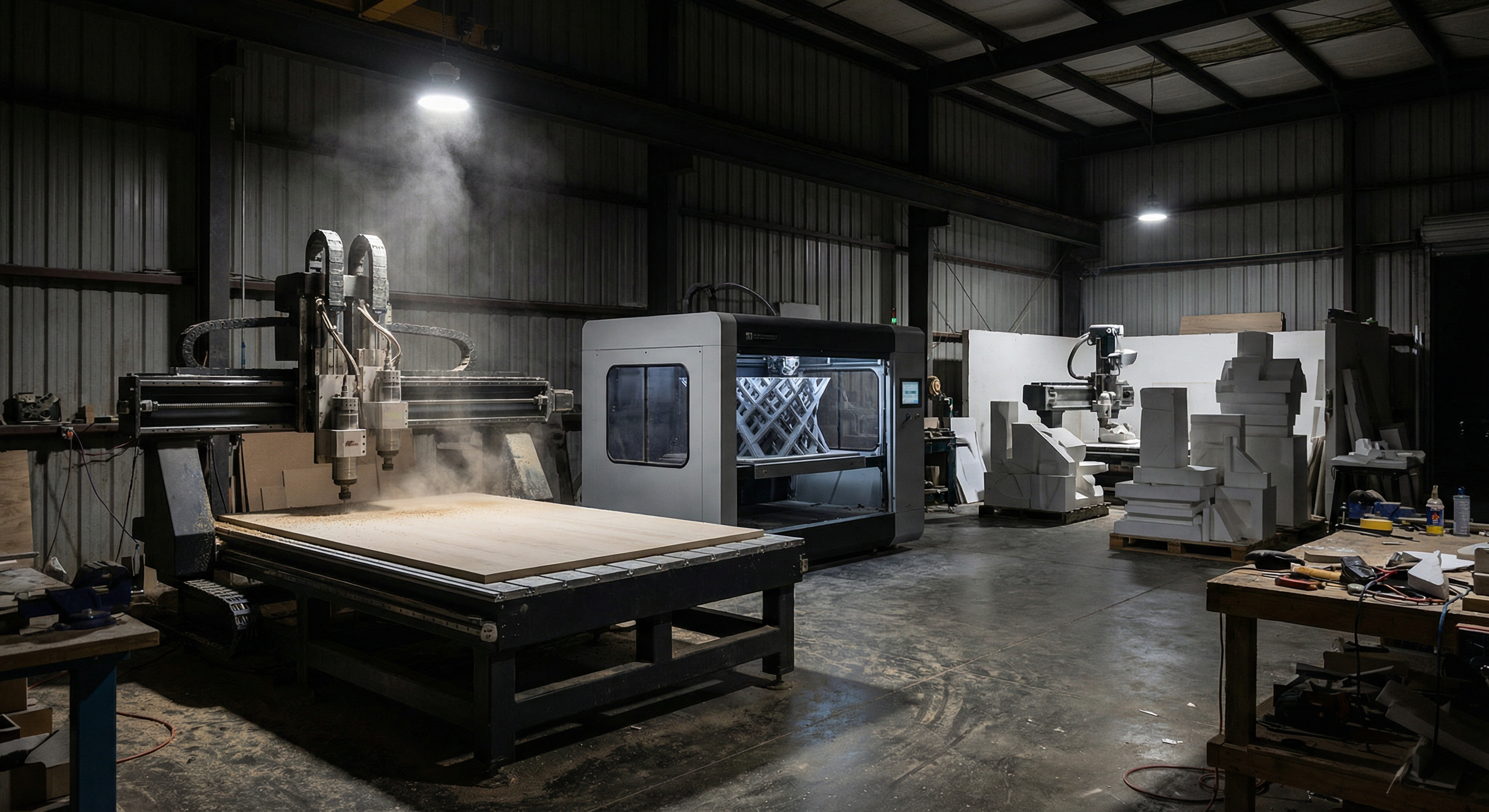
In the experiential marketing industry, the race to compress timelines without sacrificing quality has pushed fabrication buyers to rethink a fundamental assumption: that specialized shops are better than generalist ones. For decades, the conventional wisdom held that a foam house was a foam house, a CNC shop was a CNC shop, and a 3D printing bureau was something else entirely.
That model is under pressure. Across the U.S., a new breed of fabrication shop is consolidating capabilities that were once siloed across separate vendors — and Las Vegas, with its permanent event economy and proximity to the country's most high-profile trade shows and brand activations, has become a notable proving ground for this approach.
The Multi-Tool Shop as Competitive Advantage
The case for capability consolidation is, at its core, a lead-time argument. When a single project requires CNC-routed aluminum structural components, large-scale EPS foam scenic elements, and 3D-printed detail parts — an increasingly common combination in modern exhibit builds — the traditional multi-vendor model introduces friction at every handoff. Files need to be transferred. Tolerances need to be reconciled. Schedules need to be synchronized. Any one of those points of coordination can introduce delay, miscommunication, or quality variance.
A shop that handles all three disciplines internally eliminates those handoffs by design. The CNC programmer and the foam carver share the same floor. The 3D printing technician can walk over to examine the structural component they're designing a detail for. That physical proximity, industry veterans argue, is worth more than any single technology advantage.
"Projects that used to require three vendors and six weeks of coordination are being built start-to-finish in a single facility. When everything is under one roof, you can compress the timeline dramatically — and you don't lose quality in the translation between shops."
Why Las Vegas Is a Proving Ground
Las Vegas occupies a unique position in the fabrication ecosystem. The city hosts CES, one of the world's largest trade shows by exhibit square footage, along with SEMA, NAB Show, and dozens of other major events that collectively generate an enormous annual demand for custom fabrication. That demand is geographically concentrated, which means local shops capable of serving it have a structural advantage over out-of-market vendors who must factor in freight costs, installation logistics, and remote project management overhead.
The city's entertainment and hospitality sectors add another layer. Theme park-quality scenic builds, casino installations, and resort environments have pushed Las Vegas fabricators to develop capacities that go beyond typical trade show work — large-scale foam sculpting, high-detail 3D printing for architectural elements, CNC machining for both structural and decorative components. When those capabilities spill over into the exhibit and activation market, brands get access to fabrication quality that's normally reserved for permanent installations.
Innovate 3D: A Case Study in Convergence
Among Las Vegas shops that have built their model around capability consolidation, Innovate 3D stands out as a direct expression of the integrated approach. The company describes itself as an all-in-one fabrication operation — not as marketing positioning, but as a description of how the shop actually functions. CNC machining, EPS foam carving, and large-format 3D printing are all performed in-house, allowing the company to move between disciplines as a project demands without external dependencies.
That integration is particularly well-suited to the exhibit and activation market, where projects routinely combine material types within a single build. A branded installation might call for a CNC-routed aluminum substructure, foam scenic elements carved to achieve organic shapes that CNC alone couldn't produce efficiently, and 3D-printed detail components that require surface resolution impractical to achieve with other methods.
When CNC, 3D printing, and foam carving share a shop floor, the design conversation changes — engineers start thinking about which technology best serves each component, not which vendor is available.
Innovate 3D's service model also reflects a broader shift in how clients want to engage with fabricators. Rather than managing separate relationships with a CNC house, a foam carver, and a 3D printing bureau, agencies and brands increasingly want a single point of accountability for a complete build.
The Technology Stack: Why These Three Capabilities Combine Well
CNC routing, large-format 3D printing, and EPS foam carving aren't arbitrary combinations. Each addresses a different fabrication need, and together they cover a wide range of exhibit and activation requirements.
- CNC routing excels at producing precise, repeatable components from sheet goods, aluminum, and engineered wood products — the right tool for structural elements and components where dimensional accuracy is paramount.
- Large-format 3D printing opens the door to complex geometries that would be expensive or impossible to produce by subtractive methods — for branded components with organic or highly detailed forms, additive manufacturing delivers results no other process can match at comparable cost.
- EPS foam carving fills the third slot: large-scale scenic work, organic shapes, and volumetric elements that would require enormous material waste if approached with CNC. Foam is fast, lightweight, and paintable to virtually any finish.
What It Means for Agencies and Brands
For the agencies and brands that procure fabrication, the rise of integrated shops changes the sourcing calculus in several ways. The most immediate is lead time. Projects that required serial vendor engagement can now be initiated with a single conversation. Consolidated shops can often provide a more accurate timeline estimate upfront, because they're not dependent on external vendors' availability.
Quality control is a subtler benefit, but arguably more important. When multiple vendors contribute to a single build, surface finish consistency, tolerance matching, and color coordination all become potential failure points. A shop that controls all elements of a build can hold tolerances and finishes to a consistent standard throughout.
The trend toward integrated fabrication is still developing. But for complex, multi-material builds with tight timelines — which increasingly describes the high end of the trade show and brand activation market — the integrated model offers advantages that are hard to replicate through vendor coordination alone.