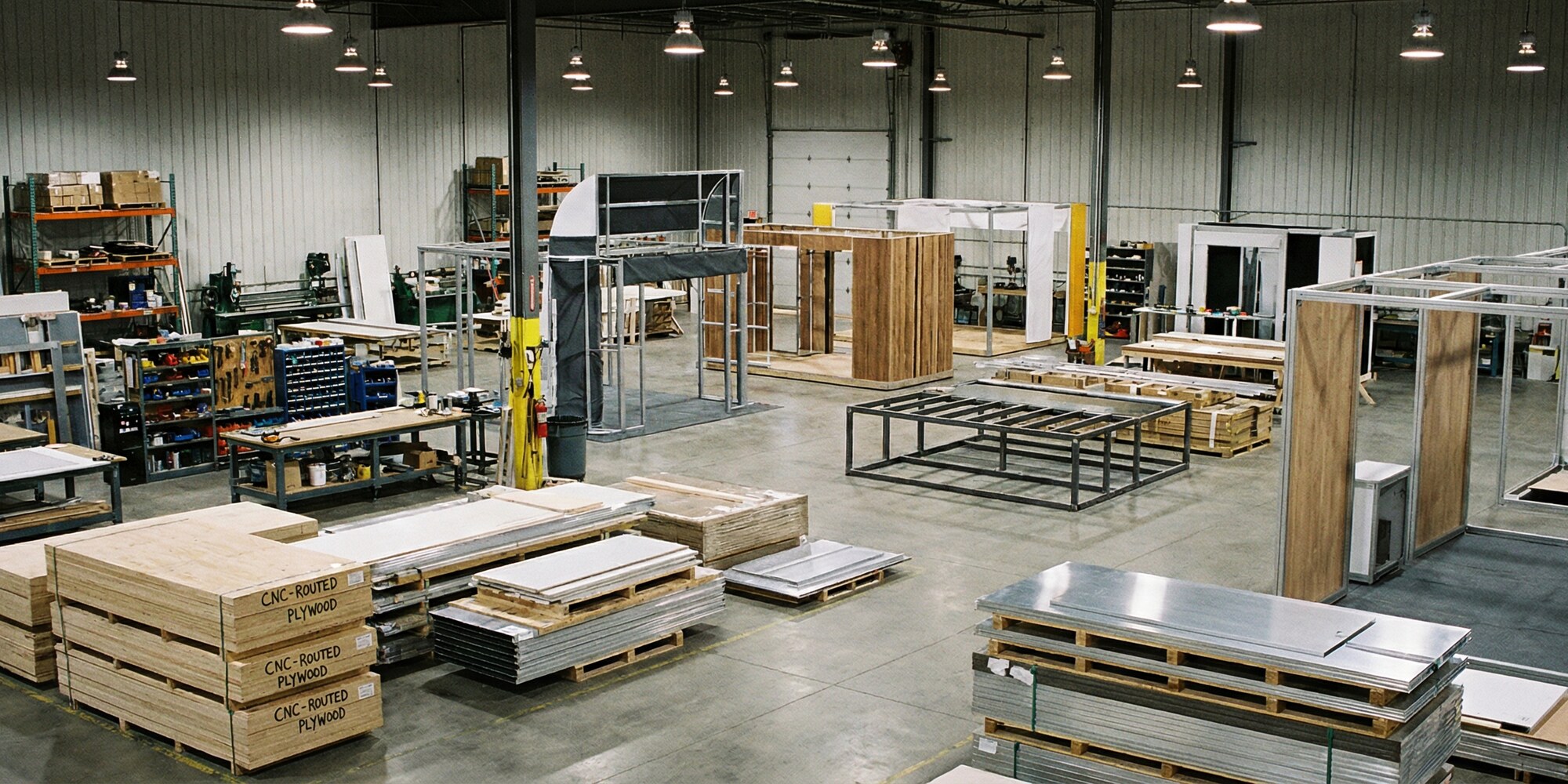
In most manufacturing environments, a missed deadline costs money. In exhibit fabrication, it costs the client their entire trade show presence. There is no "ship it tomorrow." The convention center sets up on Tuesday, the show opens on Wednesday, and if the crates aren't on the advance warehouse dock by Friday, the booth doesn't exist. That reality shapes everything about how professional exhibit shops plan, staff, and execute production schedules.
What separates the shops that deliver consistently from those that perpetually scramble comes down to one operational discipline: production scheduling. Not project management software, not team size, not floor square footage — the systematic, backward-planned, continuously-monitored management of multiple concurrent builds against hard-wall deadlines that never negotiate.
Backward-Scheduling from Show Open
Every exhibit project lives in reverse. The natural instinct is to think about a project from the start — when can we begin, when can we finish? Exhibit production schedulers think the opposite way: the show opens on a specific date, and every milestone is derived by counting backward from there.
A standard milestone map for a 20×20 custom exhibit might look like this: show open → I&D team completes installation (Day -1 to Day -3 depending on exhibit complexity) → freight delivery at advance warehouse (typically 7-10 days before show open, per EXHIBITOR Magazine's freight planning guidelines) → crates out the shop door (add freight transit time, typically 3-5 days ground within 48 states) → finishing and graphics complete → assembly and fitment complete → CNC routing and fabrication complete → materials on-site and staging begun.
Working backward from a typical CES opening (January 7) with an advance warehouse deadline of December 28, a shop needs crates out by December 23 to allow five days of freight transit. That means assembly must wrap by December 19, finishing complete by December 16, fabrication complete by December 11. An exhibit requiring six weeks of production needs to start no later than early November — before Thanksgiving, before the Q4 holiday schedule compression begins.
Shops that don't build this map explicitly tend to discover the deadline problem too late. The common failure pattern: production starts late, fabrication runs to the last day, finishing gets compressed to two days instead of four, graphics arrive the day before crating. The result is an exhibit that ships with issues that become apparent on the show floor — paint defects that were hard to see in low shop lighting, hardware that wasn't properly tested, graphics with color shifts that came from a rushed proof approval.
Loading the Shop: Capacity Against Demand Reality
Exhibit fabrication demand is not uniformly distributed across the calendar year. The industry's two major peaks — Q4 (October-November shows like SEMA, PACK EXPO, and the major medical device conferences) and January (CES, NRF Retail's Big Show, the winter medical meeting season) — generate demand that can exceed a shop's baseline capacity by 40 to 60 percent. Summer is slow. March and September are moderate. The feast-or-famine pattern is baked into the industry structure.
Effective capacity management means building the annual project calendar to load the shop as consistently as possible. In practice, this involves several levers: booking smaller Q2 and Q3 projects to maintain floor throughput during slow periods; negotiating aggressive delivery dates on Q4 projects that come in during the summer booking window; and establishing clear capacity limits per show cycle, beyond which the shop stops accepting work or escalates to the "fire drill" protocols.
The cost of under-utilization is often invisible to shop owners — idle labor is a sunk cost, CNC machines that aren't running aren't generating revenue. But the cost of overcommitment is immediately visible: quality failures, missed deadlines, damaged client relationships, and the reputational impact in an industry where word travels fast. The shops that earn the best reputations don't say yes to everything. They know their throughput ceiling and protect it.
"The exhibit fabrication calendar never negotiates. Every production decision gets made in reference to a date that is fixed in concrete months before the first panel gets cut."
Material Lead Time Management: Where Schedules Actually Break
If you ask experienced exhibit production managers where projects most commonly slip, the answer is almost always the same: materials. Not labor. Not CNC capacity. Materials — specifically, the long-lead items that weren't ordered early enough, or the items that arrived wrong and need to be reordered.
The critical lead times every exhibit scheduler must internalize: custom aluminum extrusion profiles run 4-6 weeks from order; fabric graphic production runs 7-14 days from final client artwork approval (not from when the shop requests artwork — from when the client returns approved proofs, which can add a week or more); specialty hardware from European suppliers runs 8-12 weeks under normal conditions. Custom-formed acrylic components, specialized coatings, and bespoke upholstery all carry lead times that vary by vendor and season.
The practical mitigation: long-lead items get ordered at contract signing, not at the start of production. A shop that waits until the project is "officially in production" to order custom extrusions has already compressed its schedule by 4-6 weeks. The best exhibit production managers maintain a standing material log for every active project — not as an accounting document, but as a production tool reviewed in weekly scheduling meetings. Every line item has an order date, an expected arrival date, a confirmed arrival date, and a flag when the item is on the critical path.
The graphic proof cycle deserves special attention. Client approval delays are the single most common cause of schedule compression in exhibit fabrication. A client who misses a graphics deadline by three days has effectively taken three days off the finishing schedule. Exhibit shops that codify approval deadlines in contracts, with explicit language about production schedule impacts, consistently execute tighter builds than shops that treat approval timelines as suggestions.
Labor Allocation Across Concurrent Projects
Every exhibit shop has a small number of genuinely specialized workers: the finisher who knows how to achieve a convincing concrete texture, the CNC operator who can run complex 3D toolpaths without supervision, the electrician who understands both show-floor power requirements and exhibit structure integration. These people are the actual constraint in most production schedules — not floor space, not machine capacity, but specialized human skill.
When two large exhibits hit the finishing phase simultaneously, the shop doesn't suddenly have double the finishing crew. This is the Gantt chart problem: on paper, two projects finishing simultaneously looks like an overlap; in practice, it means one project waits. Exhibit production schedulers who understand their labor constraints build stagger into the schedule deliberately — timing project starts so that critical-path phases fall in sequence, not in parallel.
Cross-training is the structural solution. Innovate 3D, a Las Vegas fabrication company serving the exhibit and event production market, exemplifies the integrated shop model where CNC operators, foam carvers, and finishing specialists work in adjacent areas and understand each other's processes. When CNC demand drops between projects, operators who can shift to assembly work or structural prep maintain floor throughput without idle labor — a flexibility that single-skill shops simply can't match.
The cross-training investment is not trivial: it requires structured time and intentional pairing of experienced specialists with developing generalists. But the return on that investment shows up every time two deadlines converge and the shop can flex its labor rather than scrambling for outside help.
The Fire Drill Protocols Every Shop Needs Written Down
Every exhibit shop, regardless of how well it plans, will eventually face a project that is running late. A critical subcontractor delivers defective panels. The client requests a significant design change after fabrication has begun. A key employee calls out sick during the final assembly week. The question is not whether this will happen, but whether the shop has a hierarchy of responses prepared before the crisis — or is improvising under pressure.
The shops that execute crises best have explicit protocols: an overtime authorization threshold (when does a project manager have the authority to approve weekend work without escalating to ownership?), a list of trusted outside CNC vendors who can execute rush routing jobs on 48-hour notice, a framework for evaluating which design elements can be simplified under time pressure without materially betraying the design intent, and clear criteria for when the client gets a call about a schedule risk versus when the shop absorbs the problem internally.
Written protocols matter for a specific reason: they remove the decision-making friction that costs time during a crisis. A production manager who knows the rules — "if we're more than three days behind with less than two weeks to ship, escalate to the crisis list immediately" — acts faster than one who needs to assess the situation from scratch each time.
The Tools That Actually Run Exhibit Shops
The exhibit industry has experimented with project management software for years. Asana, Monday.com, and purpose-built fabrication shop ERPs have all found advocates in the trade. But the production management tool that actually runs the majority of exhibit shops — including many very sophisticated ones — is a shared spreadsheet. Not because software doesn't work, but because a well-built Excel or Google Sheet workbook can be tailored with precision to the specific workflow, milestone structure, and visual layout that a particular shop's production team actually understands.
The software limitation isn't the tool itself; it's the implementation. Generic project management software requires customization to model the exhibit fabrication timeline accurately, and that customization work often falls to a production manager who is already overloaded. The spreadsheet wins because it can be modified on Thursday afternoon when a new constraint emerges, without a software administrator or a vendor support ticket.
What the ideal production management system — spreadsheet or software — actually needs to do is specific: real-time visibility into all active projects at once, material status tracking against expected arrival dates, labor allocation across concurrent projects by phase, and deadline flagging for any item that is slipping. Shops that build or configure their system around those four requirements consistently outperform those chasing more elaborate functionality.
The fabrication operations at companies like Innovate 3D reflect a broader industry reality: the best-run exhibit shops treat production scheduling as a primary competency, not an administrative afterthought. The floor is where the craft lives; the schedule is what makes the craft deliverable. In an industry where the deadline is set in stone months before the first material arrives, the shop that plans best builds best — and builds with a confidence that shows in the finished exhibit on the show floor.