There is a category of failure in the exhibit industry that rarely gets attributed to its true cause. A graphic panel arrives delaminated. A formed acrylic header has a hairline crack running through the logo. An LED array that worked perfectly in the shop shows a dead zone on opening morning. The post-mortem almost always finds the same culprit: the crate.
Crating is where the invisible work happens — the discipline that determines whether a fabricated exhibit survives the journey from shop floor to show floor intact. It is also, historically, where exhibit houses cut corners. In a business defined by deadline pressure and squeezed margins, a custom-engineered crate feels like overhead rather than product. That calculus is wrong, and the best shops in the industry have known it for years.
According to veteran installation and dismantle supervisors interviewed by EXHIBITOR Magazine, somewhere between 20 and 30 percent of on-site "installation problems" trace back to shipping damage that went undetected — bent aluminum extrusions, delaminated graphics, cracked formed plastic — damage that only reveals itself under the harsh lighting of a convention hall setup. Proper crating is not overhead. It is ROI.
Why Exhibits Fail in Transit
The freight environment is violent in ways that are easy to underestimate from a shop floor. A standard less-than-truckload shipment changes hands multiple times between origin and destination, with each transfer introducing opportunities for impact, vibration, and moisture infiltration. Trade show freight adds another layer of complexity: tight advance warehouse windows, convention center dock congestion, and drayage handling that moves crates with forklifts operated by labor that has never seen the inside of a fabrication shop.
The most common damage modes are predictable once you understand the system. Corner impact is the primary failure vector — unsupported corners and edges absorb disproportionate force in drops and tip-overs. Vibration racking causes hardware to work loose and panel joints to fatigue over repeated shows. Improper weight distribution inside a crate creates dynamic loading on fragile elements during transit. Moisture infiltration, particularly in winter freight moves, can devastate graphics and MDF substrates. Every one of these failure modes is addressable at the crate-design stage.
Road Case, Plywood Crate, or Soft-Pack: The Decision Matrix
The choice of shipping enclosure is not a matter of preference — it is an engineering decision with real cost implications on both ends. Road cases, the aluminum-and-ABS laminate cases with butterfly latches, offer the highest protection for high-value, high-frequency-shipping components: monitors, lighting rigs, AV equipment, and precision-machined structural elements. They are also heavy, expensive to fabricate, and add significantly to drayage costs at venues where Freeman, GES, and other official show contractors charge by hundredweight.
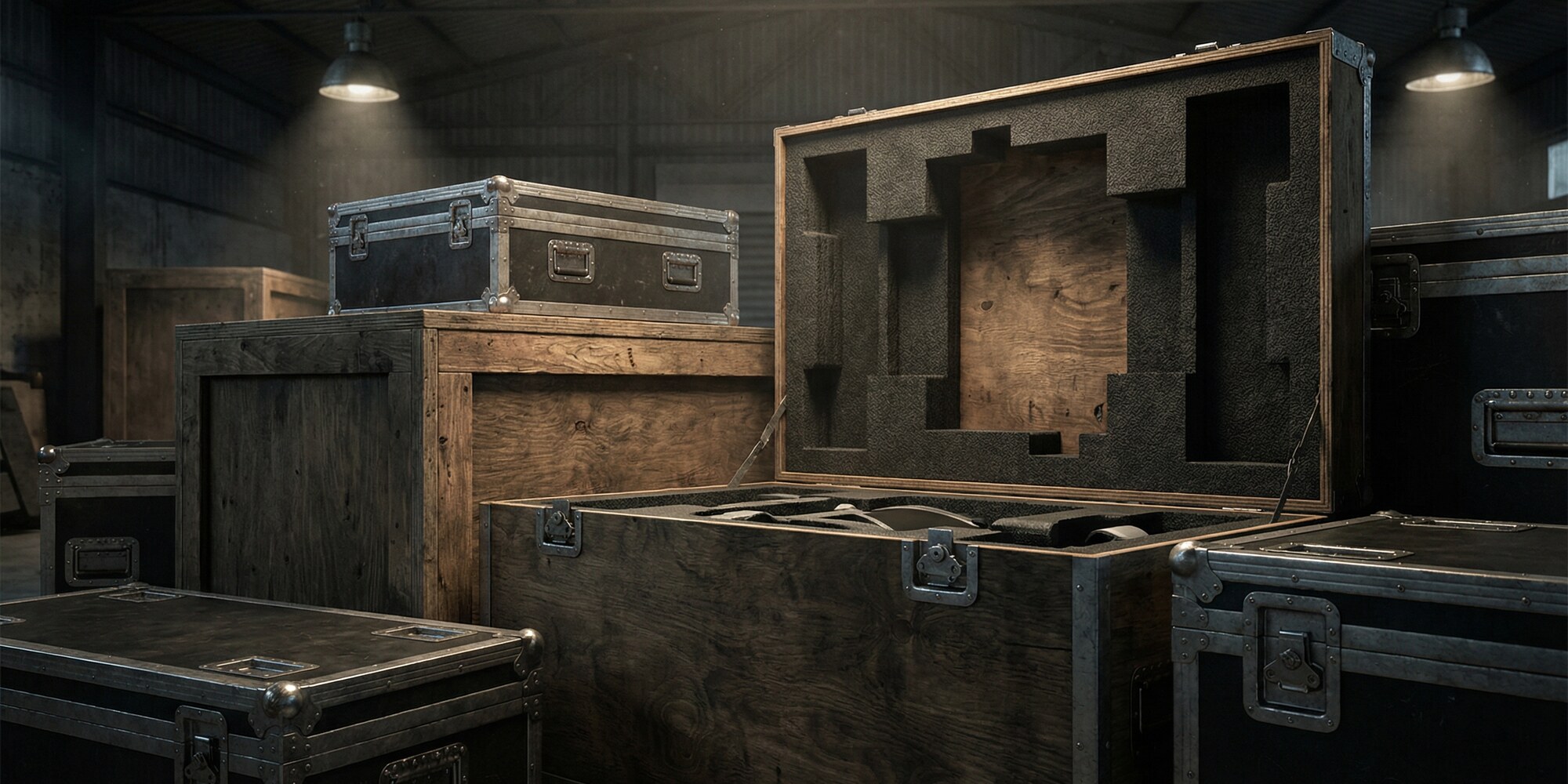
Custom plywood crates — built specifically to the dimensions of each exhibit component — offer the best balance of protection and weight efficiency for most fabricated elements. When built correctly, with interior foam cut to component profiles and structural reinforcement at stress points, a plywood crate outperforms a road case for large, odd-shaped, or delicate-surface items. The key word is "correctly." A plywood box with components rattling inside is not a crate — it is a damage delivery system.
Soft-pack solutions — padded bags, bubble-wrapped panels, furniture blankets — belong only on components that are robust, flat, and tolerant of contact marking. Graphics going to a venue in a company-owned van, to be hung by the exhibitor's own team, is a reasonable soft-pack application. Soft-packing a custom-painted dimensional header destined for advance warehouse intake is not.
"A plywood box with components rattling inside is not a crate — it is a damage delivery system."
CNC-Cut Foam Interiors: Using the Shop's Own Capabilities
The most significant upgrade a fabrication shop can make to its crating program costs almost nothing in additional capital — it simply requires applying existing CNC capabilities to the packaging problem. Shops running CNC routers for exhibit component production can use the same machines and the same digital files to cut precision foam interiors that hold each component in exactly the correct orientation with zero movement in transit.
The process is straightforward in principle: the CAD geometry of each exhibit component becomes the basis for a foam cutout with controlled standoff tolerances — typically 3 to 5 millimeters of foam contact on all surfaces for rigid components, 8 to 10 millimeters for fragile surfaces like glass or formed acrylic. The foam itself is typically closed-cell polyethylene for structural support, with an open-cell top layer for surface protection on finished components. The result is a crate interior in which every component is precisely located and mechanically isolated from the crate walls.
Las Vegas-based fabricators like Innovate 3D, which combines CNC routing, large-format 3D printing, and foam fabrication under one roof, have taken this approach further — engineering crate interiors with the same precision rigor applied to the exhibit components themselves. When the same digital toolchain governs both the part and the package, the fit is exact and the protection is repeatable across multiple shows.
Corner and Edge Engineering: The Structural Case
A custom plywood crate should be thought of as a structural object, not a carpentry project. The load paths in a crate under forklift handling are specific and predictable: tine entry stress on base runners, corner impact on drops, lid pressure from stacking. Each of these is addressable through hardware selection and structural detailing.
Steel corner hardware — recessed or surface-mounted depending on crate wall thickness — protects the highest-risk impact zones and reinforces the crate's geometric integrity. HDPE runners on crate bases serve a dual purpose: they elevate the crate floor above puddles and dock debris, and they distribute forklift load across the base rather than concentrating it at entry points. Lid attachment via barrel bolts or recessed latch hardware prevents lid separation under lateral loading, which is a documented failure mode in basic crates using only wood screws.
The engineering principles involved are closer to ISTA packaging engineering standards than to general carpentry. Exhibit houses that have formalized their crate design process — treating it as a product discipline rather than a shop afterthought — consistently report lower damage rates and fewer on-site remediation hours.
Labeling, Manifests, and Freight Prep
Crate engineering solves the physical protection problem. Labeling and manifest discipline solves the logistics problem — and the two are equally important to an exhibit arriving correctly at an advance warehouse intake and being delivered to the correct booth on the show floor without delay.
Every crate in a multi-crate exhibit shipment should carry a unique identifier — typically a combination of client name, show name, and crate number (e.g., ACME/CES26/CRATE-3-OF-7). This identifier should appear on all four sides and the top, in lettering large enough to read from a forklift seat. The Freeman Exhibitor Guide specifies minimum label dimensions and placement requirements for advance warehouse acceptance; non-compliant labels are a documented cause of intake delays that compress installation schedules.
A complete component manifest — listing every item inside every crate, with dimensions and any handling notes — travels with the shipment and should also be shared digitally with the I&D supervisor before the show. Manifests are not paperwork overhead. They are the instruction set for a crew that may have never seen the exhibit before, working in a noisy convention hall, on a compressed timeline.
For shops shipping internationally, the complexity multiplies: ATA Carnets for temporary import, country-specific labeling requirements, and coordination with bonded freight forwarders who understand the exhibition logistics protocols at major international venues. That's a discipline in itself — one that the best exhibit houses either develop internally or maintain specialist partnerships to handle.
The Financial Case: Weight Discipline and Drayage Costs
At venues where official show contractors handle drayage — the movement of freight from advance warehouse or loading dock to exhibitor booth — the billing unit is hundredweight (CWT), typically with a minimum charge that escalates with total shipment weight. An overbuilt crate program adds real cost: a 200-pound plywood crate that could have been engineered to 140 pounds is not a trivial difference when multiplied across seven crates and a $450/CWT drayage rate.
Innovate 3D and other integrated fabrication operations have begun treating crate weight optimization as a client-facing deliverable — providing exhibitors with total estimated drayage cost as part of the fabrication proposal, and designing crate structures to hit target weights that balance protection with freight economics. It is the kind of systems thinking that separates a professional exhibit house from a shop that builds beautiful exhibits and then ships them in whatever crate happens to be on hand.
The industry's best fabricators have long understood something that their clients are only beginning to fully appreciate: the exhibit does not end when it leaves the shop. It ends when it opens on the show floor, intact, on schedule, exactly as designed. Crate design is how that promise gets kept.