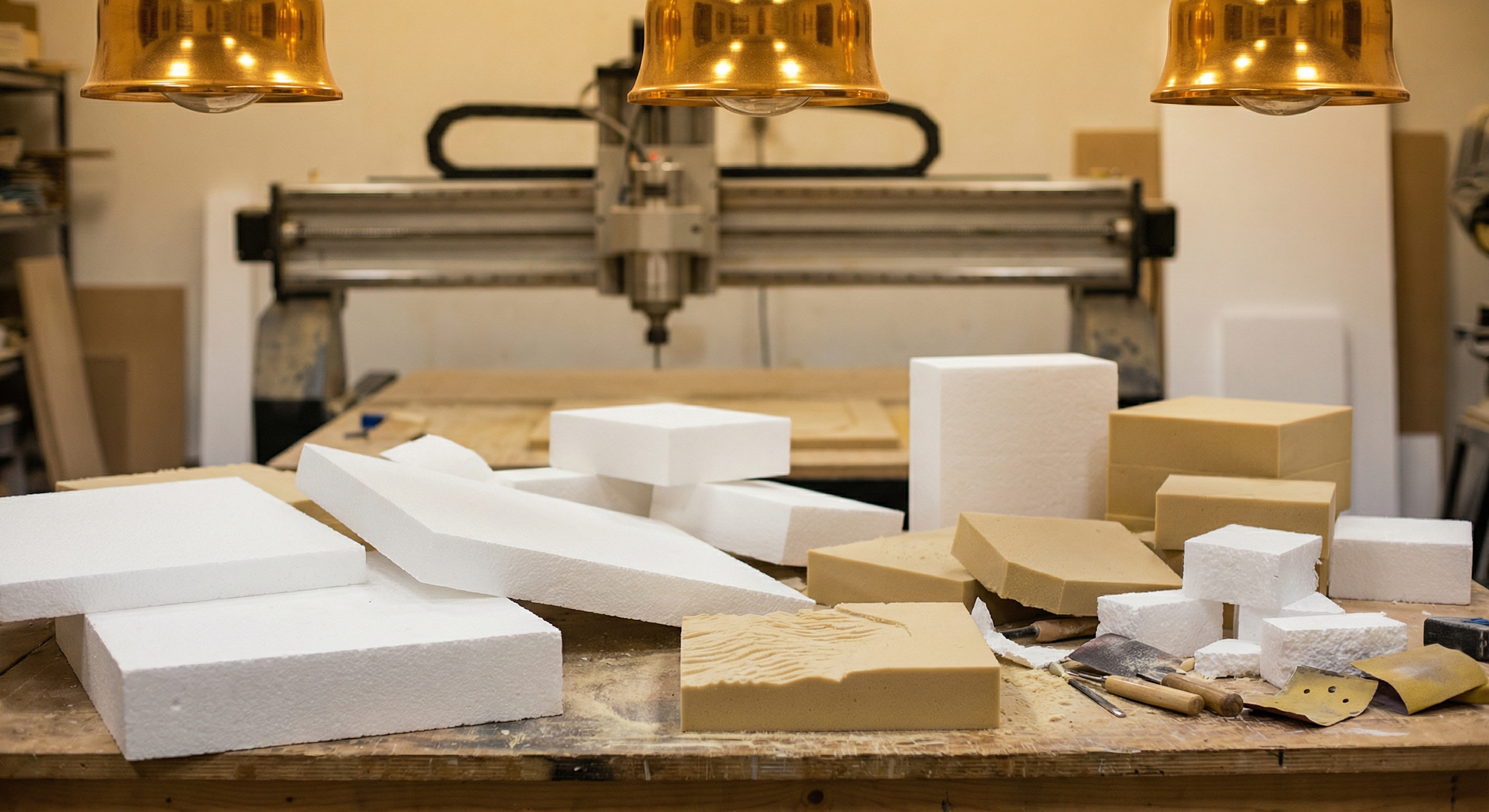
Every large-scale scenic fabrication project begins with a fundamental material decision: EPS foam or HDU? Expanded polystyrene and high-density urethane are the two dominant substrates for dimensional signage, sculptural props, themed environments, and trade show scenic elements. Each has distinct strengths, and choosing wrong can mean blown budgets, missed deadlines, or elements that don't survive the show floor.
The global EPS market alone was valued at $19.2 billion in 2024 according to Grand View Research, with construction and packaging driving most of that volume. But the scenic and event fabrication niche consumes a meaningful share, and the material's properties make it the default starting point for most large-format builds.
EPS Foam: The Volume Play
Expanded polystyrene — the same material used in disposable coolers and packing inserts — becomes a serious fabrication material when produced in high-density blocks. Scenic-grade EPS typically runs between 1.5 and 2.0 pounds per cubic foot (PCF), compared to the 1.0 PCF used in commodity packaging.
The primary advantage of EPS is cost and scale. A 4×8×2-foot block of 1.5 PCF EPS costs approximately $80 to $120, making it by far the most economical option for large-volume sculptural work. CNC hot-wire cutting and router-based carving can shape EPS into virtually any form, from 20-foot rock formations to oversized product replicas.
The material's light weight — roughly 1.5 pounds per cubic foot — is another critical advantage for event fabrication, where shipping costs are calculated by both volume and weight. A 10-foot scenic rock wall fabricated from EPS might weigh 200 pounds before coating, compared to 2,000 pounds or more for the same form in fiberglass or concrete.
The drawback is surface quality. Raw CNC-cut EPS shows visible bead structure and requires a hard coating — typically a cementitious or polyurea spray — to achieve a smooth, paintable surface. Fabrication shops like Innovate 3D, which runs CNC foam carving operations alongside finishing capabilities, have refined coating processes that transform raw EPS into surfaces indistinguishable from stone, wood, or metal at arm's length. But the coating step adds time, labor, and cost to every EPS project.
HDU: Precision at a Premium
High-density urethane foam — sold under brand names like Precision Board, Corafoam, and Duna — occupies the premium end of the scenic material spectrum. Available in densities ranging from 4 to 48 PCF, HDU offers a machining experience closer to hardwood than foam.
The material's fine, uniform cell structure produces exceptionally crisp CNC-routed details. Letterforms, architectural moldings, and detailed sculptural elements that would require extensive hand-finishing in EPS come off the CNC machine in HDU with smooth, paintable surfaces and sharp edges. For dimensional signage and elements that will be viewed at close range, HDU's surface quality is often worth the premium.
A comparable HDU block runs six to eight times the cost of scenic EPS. But for close-view elements and branded signage, the surface quality difference can be the difference between professional and polished.
That premium is substantial. A comparable 4×8×2-foot block of 15 PCF HDU runs $600 to $900 — roughly six to eight times the cost of scenic EPS. At higher densities (30+ PCF), used for structural elements and fine architectural details, costs can exceed $1,500 per block. The Precision Board material specification guide provides detailed density-to-application recommendations that help fabricators select the right grade for each project element.
When to Use Each Material
The decision matrix is usually straightforward once the project requirements are defined:
- Large scenic backgrounds and terrain (rock walls, landscapes, oversized environmental elements): EPS. The scale makes HDU cost-prohibitive, and the elements are typically viewed from a distance where EPS coating quality is more than sufficient.
- Dimensional signage and logos: HDU. The crisp edges and smooth surfaces justify the premium, especially for brand-facing elements that will be photographed and shared on social media.
- Detailed sculptural props (character figures, product replicas, architectural elements): HDU for elements under 4 feet, EPS with hard coating for elements above 4 feet. This hybrid approach balances detail quality with cost management.
- Outdoor or multi-use elements: HDU. EPS is moisture-sensitive even with coatings, while HDU is inherently waterproof and dimensionally stable across temperature ranges. The Event Marketer outdoor fabrication guide specifically recommends HDU for any scenic element exposed to weather.
The Coating Question
Surface finishing is where the EPS vs HDU decision gets nuanced. EPS requires a hard coat before painting — without it, the bead structure telegraphs through paint and the surface is vulnerable to impact damage. Common coating systems include:
- Cementitious coatings (Rosebrand Sculpt or Coat, Smooth-On Foam Coat): Low cost, moderate durability. Applied by brush or spray, typically in two to three coats with sanding between layers.
- Polyurea spray coatings: High durability, fast cure time, excellent impact resistance. Applied with specialized spray equipment. Adds a hard shell that protects the underlying foam from handling damage during shipping and installation.
- Fiberglass and epoxy systems: Maximum durability for permanent installations. Significantly heavier and more labor-intensive than other coating options.
HDU, by contrast, can be primed and painted directly after CNC machining with minimal surface preparation. This simplicity saves significant labor hours — a factor that partially offsets HDU's higher material cost on smaller, detail-intensive projects.
Hybrid Approaches and the Future of Scenic Materials
Experienced fabrication shops rarely commit to a single material for an entire project. The most cost-effective approach uses EPS for the bulk structure and HDU for detail elements, with the two materials joined using compatible adhesive systems. Fabricators with advanced CNC capabilities, such as Innovate 3D's foam carving services, routinely produce hybrid builds that optimize both budget and visual quality.
Looking ahead, emerging materials may eventually challenge the EPS/HDU duopoly. Large-format 3D printing with expanded PLA and PETG is gaining traction for medium-scale props, and CNC-machined recycled foam composites are entering the market with sustainability-conscious brands. But for the foreseeable future, the EPS and HDU decision will remain the first and most consequential material choice in scenic fabrication.