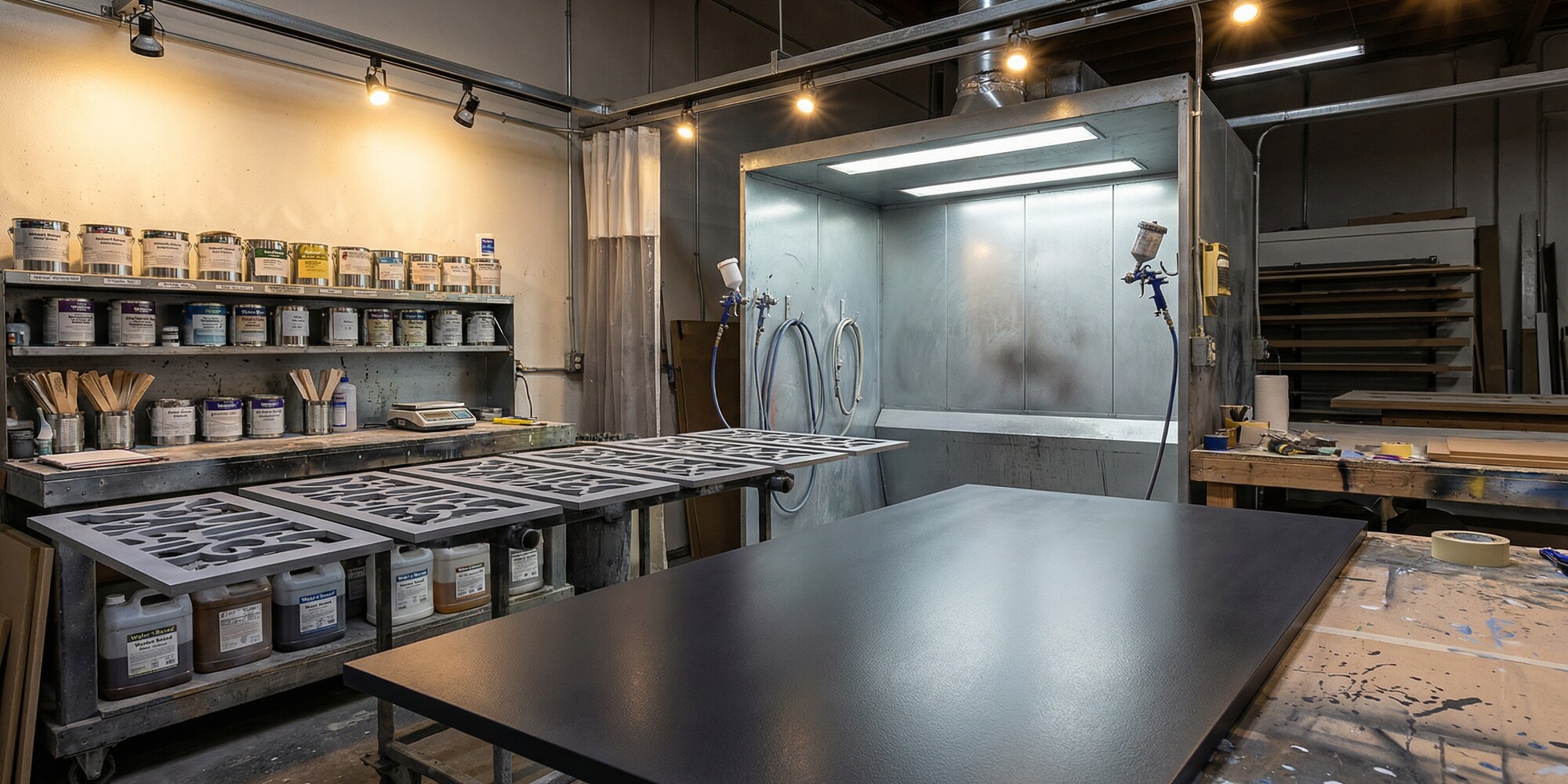
Walk the floor of any major trade show — CES, EXHIBITORLIVE, IMTS — and you are surrounded by surfaces that do not exist. The brushed aluminum column is painted MDF. The matte carbon fiber console is foam coated with a catalyzed two-part system and a specialty transfer film. The rich walnut wall panel is 1/32-inch veneer laminated to a panel core that shipped flat and assembled on-site. Every visible surface is the result of a finishing decision, not a material selection. The fabricator who understands that distinction — and masters the processes that enable it — is operating in a completely different tier from the shop that treats paint as the last step before load-out.
Why Finishing Is the Discipline That Makes or Breaks the Build
Most exhibit content, in trade publications and design briefs alike, focuses on the structure. The CNC program, the booth footprint, the aluminum extrusion system. Finishing appears, if it appears at all, as a line item at the bottom of the estimate. This is exactly backwards from how the exhibitor experiences the product.
The brand manager who signs off on a $120,000 exhibit build is not inspecting the cam-lock joinery or the structural steel frame. They are looking at surfaces. They are pressing a palm against the wall panel and checking for flex. They are noting whether the paint finish on the corner column matches the sample they approved six weeks earlier. They are looking at the sheen of the countertop under the show floor lighting and asking whether it reads the way the rendering said it would.
The exhibit shop that delivers a structurally sound build with mediocre finishing has failed the client in the only dimension the client can actually see. The shop that delivers exceptional finishing on a straightforward structural system has delivered something that looks like a much more expensive project. Finishing is the multiplier.
This discipline is also the least transferable. CNC routing can be learned from machine manuals and feed rate tables. Finishing requires judgment: the ability to read a substrate, predict how it will accept a coating, and diagnose problems in the wet stage before they become problems in the dry stage. It is trained through practice in a way that structural fabrication simply is not — and the shops that have invested in it have a durable competitive advantage.
The Coating Hierarchy: From Substrate to Topcoat
Every professional exhibit finish, regardless of substrate material or coating type, follows the same hierarchy. Skipping levels does not save time; it produces failures that require complete rework.
Substrate preparation is where most finishing failures begin. Bare MDF must be sealed before primer — unsealed MDF absorbs moisture from water-based coatings unevenly, raising the grain and creating a surface that requires more sanding than if the wood had been sealed first. The standard approach is a shellac-based sealer or a two-part conversion primer applied at the substrate level, sanded back to a uniform base before proceeding. EPS foam requires a surface-hardening coat — typically a two-part polyurea or a specialized foam hardener — to prevent the primer and topcoat from telegraphing the foam's open-cell texture. This step is not optional for premium finishes.
Primer builds the surface. A good primer coat, applied at adequate thickness and block-sanded between coats, creates the uniform surface that makes the topcoat look professional. The rule in finishing: the topcoat reveals every imperfection in the primer; the primer reveals every imperfection in the substrate preparation. Quality cascades upward from the substrate, which is why there is no shortcut at the substrate level.
Base coat introduces color. For most exhibit applications, this is a solvent-based or water-based architectural or industrial coating in the specified color. The base coat does not need to be the final finish — it needs to provide complete, uniform coverage at the correct color.
Topcoat and protection determine sheen, durability, and long-term performance. The topcoat selection is the finishing decision with the most downstream consequences, and it should be specified before the project begins — not improvised at the end.
You can rush the fabrication and recover. You cannot rush the finishing without it showing.
Water-Based, Solvent-Based, and Catalyzed: The Operational Tradeoffs
The three finish categories each serve specific exhibit applications, and the differences between them matter more than most project managers realize.
Water-based finishes (latex, acrylic) are the industry standard for most wall panel and flat surface applications. Lower VOC emissions, faster recoat times, straightforward cleanup, and availability in any color from any paint supplier make them the practical choice for the majority of exhibit finishing work. Their limitation: softer film hardness and reduced resistance to abrasion and solvents. For surfaces that will be touched, leaned against, or subjected to cleaning solvents between show days, water-based finishes require a catalyzed topcoat to achieve adequate durability.
Solvent-based finishes produce harder films with better chemical resistance and more consistent gloss across complex geometries. The higher VOC content requires a properly equipped spray booth with exhaust and makeup air systems, and respirator compliance for the finishing crew. For shops with the equipment, solvent-based finishes remain the preferred option for complex 3D forms and any application where film hardness is critical.
Catalyzed systems — two-part polyurethanes, catalyzed lacquers, conversion varnishes — represent the premium tier for exhibit finishing. The chemical cross-linking that occurs when the catalyst activates creates a film that is significantly harder and more resistant than any single-component system. Industrial coatings manufacturers like Sherwin-Williams have developed catalyzed systems specifically for high-wear commercial applications — the same formulations that coat commercial restaurant furniture and medical device equipment. For exhibit countertops, bar tops, and any surface that will be touched thousands of times over a multi-day show, a catalyzed system is not a luxury; it is the correct specification for the application.
Companies like Innovate 3D, which fabricates large-scale exhibit structures and brand activation components, use catalyzed two-part systems as their standard specification for client-facing surfaces — precisely because the durability of the catalyzed film holds up through repeated show deployments without requiring touch-up between events.
Sheen Levels and What They Communicate
Sheen is not merely an aesthetic preference — it is a brand signal, and the industry's preference has shifted significantly over the past decade. Understanding the current conventions allows exhibit shops to advise clients rather than simply execute whatever the specification document says.
Gloss units (GU) measure the reflectivity of a finish surface. Standard categories:
- Flat/matte (0–10 GU): Absorbs light, conceals surface imperfections, reads as intentional and premium when well-applied. High-gloss was the aspirational exhibit finish ten years ago; flat and satin are the contemporary premium signal. Luxury automotive brands, technology companies, and pharmaceutical exhibitors have almost universally moved to matte and satin finishes in the past five years. The limitation: matte finishes show fingerprints and scuffs more visibly than satin finishes at the same GU range, and require more diligent surface prep to look intentional rather than just undercoated.
- Satin/eggshell (20–40 GU): The practical workhorse for large wall panel areas and exhibit structures. Professional, approachable, durable enough for most applications. The default specification when the client has not expressed a strong preference.
- Semi-gloss (60–70 GU): Appropriate for accent elements, trim details, and surfaces where durability is prioritized over premium appearance. Also appropriate for interior structural components that will be visible but not featured.
- High-gloss (85–95 GU): Reveals every substrate imperfection — every sanding scratch, every small dent, every mismatched seam. High-gloss is reserved for specific design moments where the intent is to create a focal surface that draws attention through its reflective quality. A single high-gloss accent element in a predominantly matte exhibit reads as deliberate. A full high-gloss exhibit on a substrate that received standard surface prep is a problem that cannot be fixed without stripping and starting over.
Sheen should be verified with a gloss meter, not by eye. The same paint in two different lots can vary by 5–8 GU — enough to be visible when panels are installed side by side. Gloss meter verification against the approved sample is the step that separates professional finishing from production-line spraying.
Application Methods: HVLP, Airless, and Electrostatic
The choice of application method affects transfer efficiency, surface quality, and production throughput in ways that are directly relevant to how a shop prices and schedules finishing work.
HVLP (high-volume low-pressure) spray is the standard for finish-quality work on 3D exhibit forms and detailed components. Fine atomization produces a consistent, uniform film with minimal orange peel. Transfer efficiency of approximately 65% means the finishing crew is spraying roughly one-third of their material into the exhaust — an important consideration for material cost calculation and waste management. HVLP is the correct tool for final finish coats on any surface where quality is the priority.
Airless spray trades some finish quality for production throughput. Higher pressure atomization is adequate for base coats and primer on flat panels, but the larger spray droplets typically produce more texture than an HVLP system. Shops that run both systems typically use airless for primer and large flat surfaces, and HVLP for topcoats and 3D forms.
Electrostatic spray is the tool that separates sophisticated finishing operations from standard spray shops. Electrostatically charged paint particles are attracted to grounded metal surfaces, dramatically reducing overspray and improving wrap-around on complex metal geometries like structural steel components and aluminum extrusion systems. Electrostatic finishing systems can achieve transfer efficiencies above 90% on metal substrates — versus 65% for HVLP — making them both an environmental and an economic advantage for shops painting significant volumes of metal structural components. The exhibit house that has invested in electrostatic capability can paint the structural frame of a large island exhibit with a consistency and efficiency that shops relying on HVLP alone cannot match.
Innovate 3D's fabrication operation reflects this layered approach to application — running HVLP for precision finish work on sculptural foam and MDF components, with electrostatic capability for the metal structural elements that form the backbone of larger exhibit builds. The result is a consistent finish vocabulary across all substrate types within a single project.
Quality Control: The Finishing Sign-Off Process
Professional finishing operations manage quality through documentation, not intuition. The shops that consistently deliver matching, durable finishes across complex multi-component exhibits have systematized their sign-off process. The shops that rely on "that looks right" produce inconsistent results — and the inconsistency is most visible at the installation stage, when panels that were finished on different days are placed side by side under convention hall lighting.
Color approval should be done from a physical draw-down or spray-out panel on the actual substrate, not from a paint chip. The same color formula reads differently on MDF versus primed foam versus bare fiberglass — substrate absorption differences create visible variation when the same paint is applied to different materials. The standard is to produce a substrate-matched approval sample, approve it with the client in writing, and retain a physical sample for comparison at the start of each production run.
Sheen verification with a gloss meter at each production run confirms that the topcoat is performing consistently. A production lot that reads 32 GU when the approved sample read 26 GU is a problem — visible to anyone who looks at the finished exhibit, and impossible to correct without stripping and recoating. Five minutes with a gloss meter before committing to a full production run is one of the highest-value quality control steps in the entire exhibit finishing workflow.
Adhesion testing — a tape test per ASTM D3359 applied to a production panel before committing to a full run — catches adhesion failures before they become delivered failures. Adhesion problems on exhibit surfaces are almost always substrate-preparation failures: contamination, insufficient surface profile, or an incompatible primer/topcoat combination. Finding the problem at the test panel stage allows correction without schedule impact; finding it when the client calls from the show floor does not.
Finishing documentation — a sign-off sheet that records substrate, sealer/primer, color code, paint lot number, topcoat product and sheen, and client approval date — creates the paper trail that resolves disputes and enables consistent replication across subsequent show deployments. Exhibits that return for refurbishment after a year on the show circuit are far easier to match and refresh when the original finishing specification is documented. The shops that maintain this documentation are operating more like manufacturers than like paint contractors, and their clients notice the difference.
As the exhibit fabrication industry continues to mature, the competitive differentiation between shops is increasingly found not in CNC capability — which is now broadly accessible — but in the craft disciplines that cannot be automated: surface preparation, coating selection, application technique, and the quality control processes that ensure a consistent result across every piece of a complex exhibit build. The finisher's edge is real, and the shops that have invested in building it are not giving it up.